
Ertiga / Carens
👥 5–6🧳 3 bags
Family with elderly parents; 2–3 day circuits
The Devi and Chalukyan-heritage circuit of north Karnataka — Saundatti Yellamma, Banashankari, the temple towns of Badami and Pattadakal, and the Virupaksha temple of Hampi.
North Karnataka pairs living Shakti worship with the cradle of South Indian temple architecture. Saundatti's Yellamma (Renuka) temple on a hilltop is a major Devi pilgrimage; Badami's Banashankari and the rock-cut heritage of Badami, Aihole and Pattadakal (a UNESCO site) mark the Chalukyan golden age.
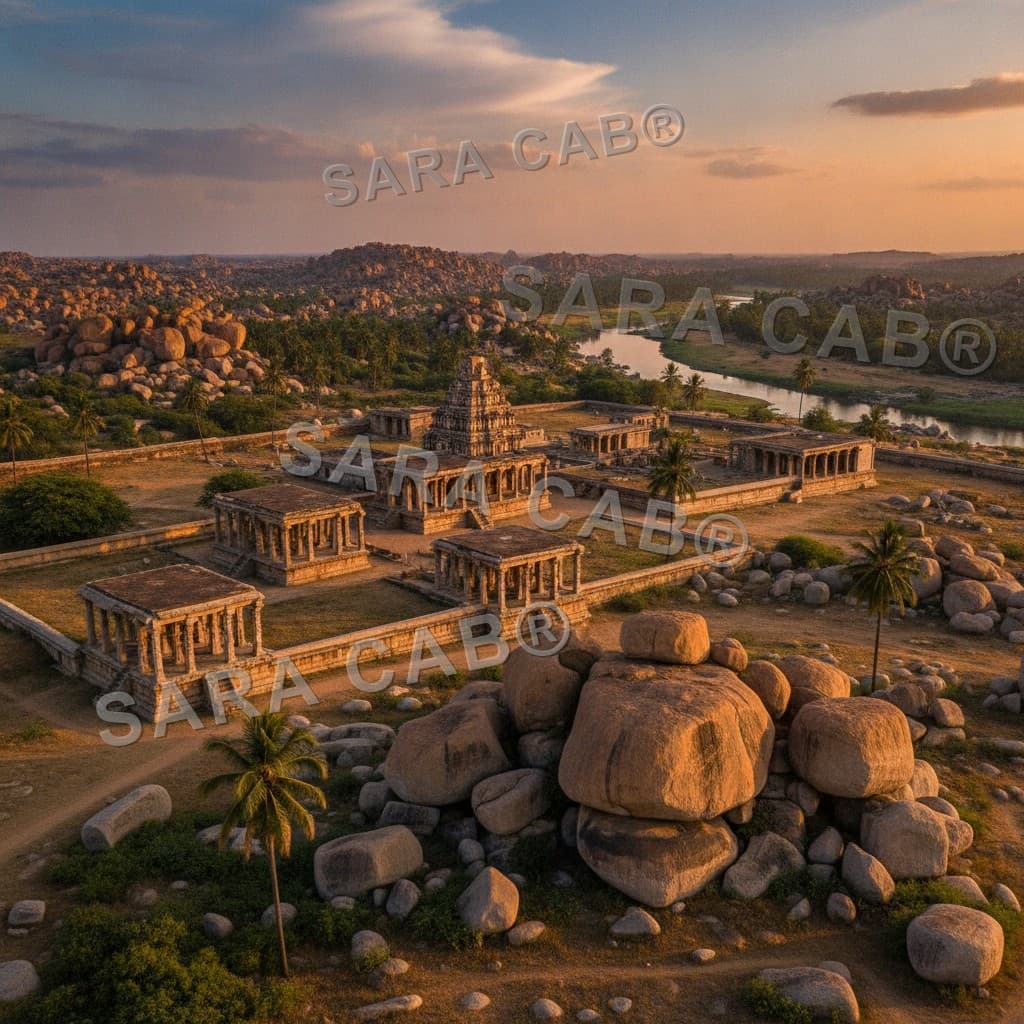
The circuit culminates at Hampi, where the Virupaksha temple has been in continuous worship since the Vijayanagara empire, set among a UNESCO-listed landscape of ruins and boulders — a journey through devotion and India's temple-building history.
Perched on the Ramalinga hill near Saundatti in Belagavi district, the Yellamma temple is dedicated to the Goddess Renuka, widely revered as Yellamma, the mother of all. Traditionally associated with the legend of Renuka and the sage Jamadagni, the shrine is one of the most important Shakti centres of north Karnataka and draws vast numbers of rural devotees. The hilltop setting and the nearby sacred tank lend the kshetra a rustic, deeply devotional character.
Pilgrims climb to the hilltop for darshan of the goddess and to fulfil vows, with the temple witnessing enormous gatherings during its full-moon fairs, especially around the Bharata Hunnime. Traditional attire is customary. The approach involves a climb and steps, so elderly visitors may need assistance, though transport eases part of the way. The cooler months are most comfortable given the region's heat. Badami and its cave temples make a natural heritage add-on.
Located a short distance from Badami, the Banashankari temple is dedicated to the Goddess as Banashankari or Shakambhari, a form of Parvati traditionally revered as the bearer of vegetables and giver of nourishment. The presiding deity is depicted in a striking black-stone image seated upon a lion. The temple, set beside the large Haridra Tirtha tank with its colonnaded steps, has ancient origins and remains a much-frequented Shakti shrine in the Bagalkot region.
Devotees come for darshan of the goddess and to seek her blessings for prosperity and well-being, with the annual Banashankari fair drawing large crowds over several days. Traditional attire is expected. The temple and tank precinct are largely level and manageable for elders. The cooler, drier months are far more comfortable in this arid region. The site pairs naturally with Badami's rock-cut caves, Aihole and Pattadakal for a rich heritage circuit.
Pattadakal, on the banks of the Malaprabha river, is a UNESCO World Heritage Site celebrated as a high point of Chalukyan temple building from the 7th and 8th centuries. Here northern Nagara and southern Dravida architectural styles stand side by side, most notably in the grand Virupaksha temple built to commemorate a Chalukyan military victory. Historically a place of royal coronations, the cluster of sandstone temples represents a remarkable experiment in temple design and sculptural richness.
Visitors come to admire the architecture and carvings, and several temples remain sites of periodic worship. Modest attire is appropriate at the active shrines. The monuments stand in an open, largely level compound that is comfortable for elders, though shade is limited. The cooler months are strongly preferable given the summer heat. Pattadakal is best experienced together with nearby Aihole and Badami, completing a celebrated early-Chalukyan heritage trail.
At the heart of the World Heritage ruins of Hampi, the Virupaksha temple is a living shrine dedicated to Lord Shiva as Virupaksha, consort of the local goddess Pampa, after whom the region is named. With roots reaching back centuries and grand expansion under the Vijayanagara empire, its towering eastern gopura dominates the sacred landscape along the Tungabhadra river. It remains an active place of worship amid one of India's most evocative historical sites.
Pilgrims come for darshan of Virupaksha, while many visitors also explore the vast Vijayanagara ruins that surround the temple. The annual chariot festival and other celebrations draw large gatherings. Traditional attire is appropriate. The main temple is largely level and accessible, though the wider Hampi site involves considerable walking over uneven terrain best suited to the able-bodied. Cooler months are essential given the heat, and the boulder-strewn ruins offer abundant add-ons.
Hilltop Yellamma (Renuka) Devi temple.
Banashankari, Mahakuta and Badami cave temples.
Pattadakal (UNESCO) and on to Hampi.
Virupaksha temple and the Hampi ruins, then return.
Recommended for this circuit — we finalise by your group size and luggage.
The North Karnataka Shakti & Heritage Circuit covers Saundatti Yellamma, Badami Banashankari, Mahakuta, Pattadakal, Hampi Virupaksha, driven from Hubballi / Belagavi over 4 Days / 3 Nights.
This is a direct road trip — a SARA CAB chauffeur-driven vehicle departs from Hubballi and runs the entire circuit.
We recommend Ertiga / Carens, Innova Crysta / Hycross, Tempo Traveller (12–20), chosen by your group size and luggage.
This circuit is quoted on request — airfare, season and permits vary — so share your dates and group size for an exact, all-inclusive quote.
Fare on request
Quote on request
Share your dates & group for an exact, all-inclusive quote.
Pick your dates and vehicle for an exact cab fare.
Tourist-permit vehicles, fully compliant
Uniformed, experienced, route-savvy drivers
Backend-calculated fares · no hidden charges
Clean vehicles, live tracking on every trip
Book, change or ask — any time
★★★★☆“Innova Crysta rental — the best service in Chennai at a cheap and fair price.”
— Google review, Chennai
★★★★☆“Hired a 33-seater bus — clean, professional and it arrived on time, better than other travels.”
— Google review, Mysore
★★★★★“A very amazing, comfortable and fun trip — I'll definitely recommend SARA CAB for Ooty and Mysuru.”
— Google review, Mysore
★★★★☆“Mysore railway station pickup to Sri Ranganathaswamy temple — the driver knew the local routes and timings well, at the best price.”
— Google review, Mysore
★★★★★“Found SARA CAB on Google for a sedan rental and enjoyed my whole day trip — thank you, Tarachand!”
— Google review, Bangalore
Booking just the cab? See Bangalore To Hampi cab fares.