
Ertiga / Carens
👥 5–6🧳 3 bags
Family with elderly parents; 2–3 day circuits
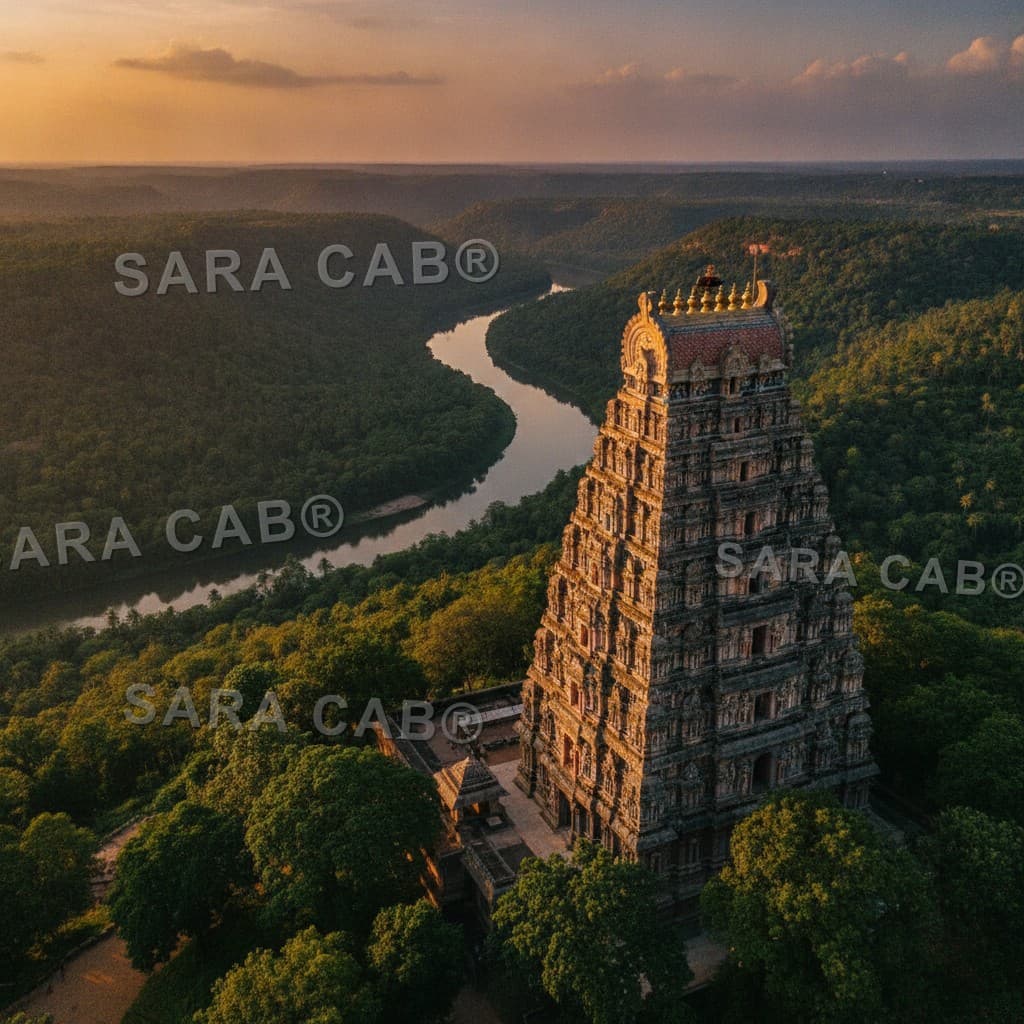
Srisailam — both a Jyotirlinga and a Shakti Peetha — with the nine Narasimha shrines of Ahobilam and the natural wonders of Mahanandi and Yaganti in the Nallamala hills.
Srisailam's Mallikarjuna is unique as both one of the twelve Jyotirlingas of Shiva and, with Bhramaramba, one of the eighteen Maha Shakti Peethas — a rare confluence set deep in the Nallamala forest above the Krishna river.
Ahobilam, the Nava Narasimha Kshetram, spreads nine Narasimha shrines across forested hills and is the primary abode of the fierce man-lion avatar; Mahanandi's spring-fed tanks and Yaganti's growing Nandi idol add natural marvels to a rugged, deeply devotional circuit.
Srisailam, set amid the Nallamala forests on the Krishna river, is revered as the site of one of the twelve Jyotirlingas, where Lord Shiva is worshipped as Mallikarjuna Swamy alongside the goddess Bhramaramba Devi, honoured as one of the Ashtadasa Shakti Peethas. This rare confluence of a Jyotirlinga and a Shakti Peetha makes it among the holiest hill shrines in the south. Traditionally linked to legends of Shiva and Parvati, its fortified temple carries centuries of devotion and stone artistry.
Pilgrims come for darshan of both the lingam and the goddess, and the hill setting beside the Krishna adds to its sanctity. Traditional attire is customary. The temple involves some walking and steps within the complex. Maha Shivaratri is celebrated on a grand scale. Cooler months are generally pleasant for the forest-hill journey, and the winding ghat road calls for a comfortable vehicle. Nearby the Srisailam dam and viewpoints are popular add-ons, and Ahobilam pairs well with this circuit.
Ahobilam, in the Nallamala hills, is revered as a foremost kshetra of Lord Narasimha, the man-lion avatar of Vishnu. It is traditionally associated with the legend of Narasimha slaying Hiranyakashipu to protect the devotee Prahlada. The site is unique for its Nava Narasimha shrines, nine forms of the deity spread across the lower town (Diguva Ahobilam) and the upper hills (Eguva Ahobilam), each with its own legend, drawing devotees who seek to visit the entire cluster.
Darshan of the principal shrines is straightforward, while several of the nine temples lie on forest trails and rocky ascents that require trekking and moderate fitness. Traditional attire is customary. Cooler months are broadly comfortable for the hill walks, and pilgrims are advised to start early. Brahmotsavam and Narasimha Jayanti are celebrated with devotion. Ahobilam combines naturally with Srisailam, Yaganti and Mahanandi as part of a wider Rayalaseema and Nallamala pilgrimage.
Yaganti, in the Kurnool region, is a cave-set Shiva temple dedicated to Uma Maheswara, revered for its natural rock setting and self-manifested lingam. Traditionally linked to sage Agastya, the temple is renowned for its stone Nandi, which devotees believe is gradually growing in size over the years. Freshwater springs feed the temple tank from the surrounding hills, and the caves nearby, associated with saints, add to the site's spiritual and geological fascination cherished by visiting pilgrims.
Pilgrims take darshan of the lingam and the celebrated Nandi, and explore the hill caves, some of which involve climbing steps. Traditional attire is customary. Maha Shivaratri is observed with devotion. Cooler months are generally pleasant for the rocky terrain. The unusual absence of crows here is part of local legend. Yaganti is commonly combined with Mahanandi and Ahobilam, forming a scenic Rayalaseema temple circuit through the Kurnool countryside.
Mahanandi, near Nandyal in the Nallamala foothills, is an ancient Shiva temple counted among the group of Nandi shrines known as the Nava Nandis. The presiding deity, Mahanandiswara, is worshipped in a lingam of great antiquity, and the temple is celebrated for its perennial spring-fed pools whose water remains remarkably clear and constant through the year. Its early medieval architecture and tranquil setting amid greenery make it a serene and revered stop for pilgrims.
A distinctive feature is the sacred tanks (kalyani) where devotees bathe in the clear flowing water before darshan. The temple is on generally level ground and is comfortable for most visitors. Traditional attire is customary. Maha Shivaratri is the principal festival. Cooler months are broadly pleasant for travel. Mahanandi pairs naturally with Yaganti, Ahobilam and Srisailam, and the wider set of Nava Nandi shrines nearby appeals to those undertaking a fuller circuit.
Mallikarjuna Jyotirlinga and Bhramaramba Shakti Peetha.
Mahanandi's spring-fed temple tanks.
Nava Narasimha shrines across the hills.
Yaganti Uma Maheshwara and the growing Nandi, then return.
Recommended for this circuit — we finalise by your group size and luggage.
The Srisailam Jyotirlinga & Ahobilam Circuit covers Srisailam Mallikarjuna & Bhramaramba, Mahanandi, Ahobilam (Nava Narasimha), Yaganti Uma Maheshwara, driven from Hyderabad / Kurnool over 4 Days / 3 Nights.
This is a direct road trip — a SARA CAB chauffeur-driven vehicle departs from Hyderabad and runs the entire circuit.
We recommend Ertiga / Carens, Innova Crysta / Hycross, Tempo Traveller (12–20), chosen by your group size and luggage.
This circuit is quoted on request — airfare, season and permits vary — so share your dates and group size for an exact, all-inclusive quote.
Fare on request
Quote on request
Share your dates & group for an exact, all-inclusive quote.
Pick your dates and vehicle for an exact cab fare.
Tourist-permit vehicles, fully compliant
Uniformed, experienced, route-savvy drivers
Backend-calculated fares · no hidden charges
Clean vehicles, live tracking on every trip
Book, change or ask — any time
★★★★☆“Innova Crysta rental — the best service in Chennai at a cheap and fair price.”
— Google review, Chennai
★★★★☆“Hired a 33-seater bus — clean, professional and it arrived on time, better than other travels.”
— Google review, Mysore
★★★★★“A very amazing, comfortable and fun trip — I'll definitely recommend SARA CAB for Ooty and Mysuru.”
— Google review, Mysore
★★★★☆“Mysore railway station pickup to Sri Ranganathaswamy temple — the driver knew the local routes and timings well, at the best price.”
— Google review, Mysore
★★★★★“Found SARA CAB on Google for a sedan rental and enjoyed my whole day trip — thank you, Tarachand!”
— Google review, Bangalore