
Ertiga / Carens
👥 5–6🧳 3 bags
Family with elderly parents; 2–3 day circuits
The complete Arupadai Veedu — the six sacred battle-camps of Lord Murugan across Tamil Nadu, driven end to end with a chauffeur who knows the darshan timings at each hill shrine.
The Arupadai Veedu are the six abodes where, in the Skanda tradition, Lord Murugan (Kartikeya) is enshrined at the key moments of his story — from Thiruparankundram, where he wed Devasena, to Tiruchendur on the shore where he vanquished Surapadman, and Palani, the hill of the renunciate holding his staff. Together they form Tamil Nadu's most beloved pilgrimage, drawing devotees for kavadi vows and hill-climb darshan.
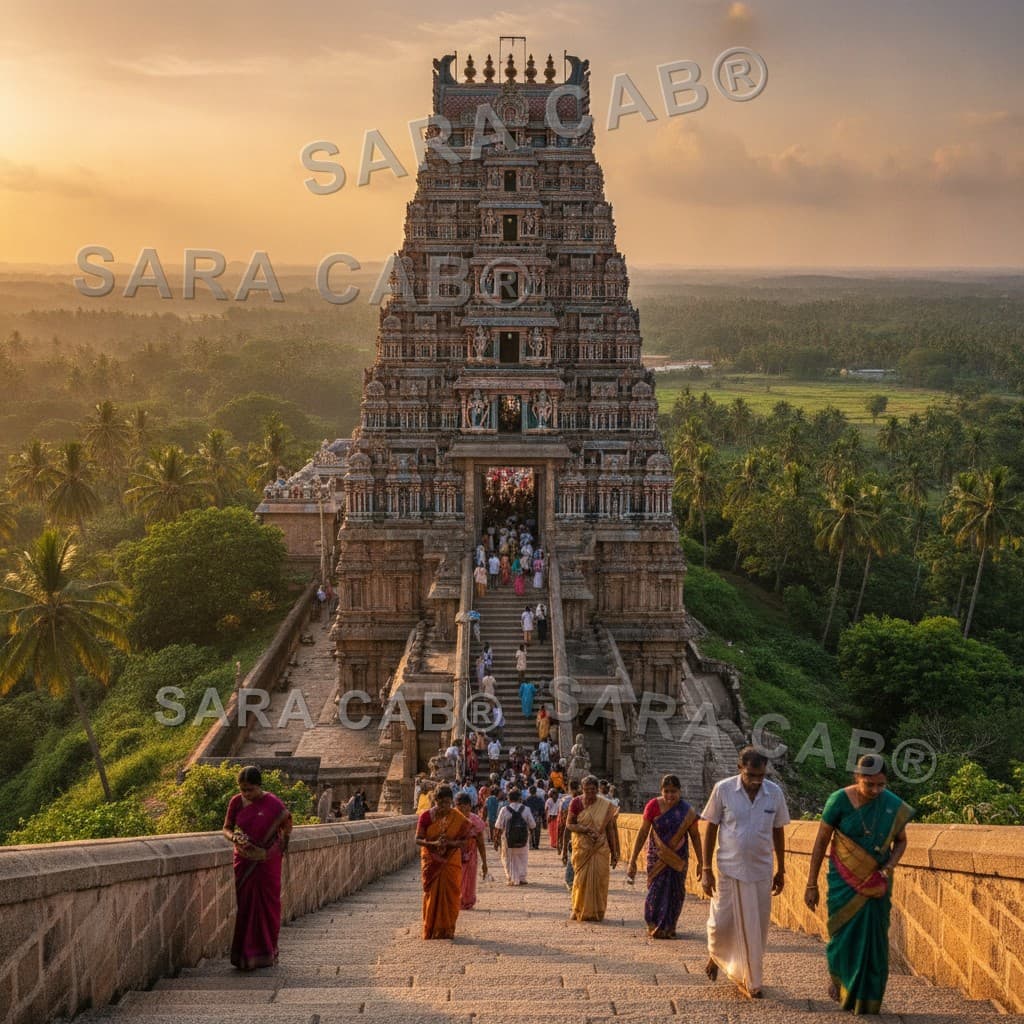
The circuit blends coastal, plains and hill temples, so pacing matters: Palani's winroad and steps, Tiruchendur's seaside sanctum and the quiet grove of Pazhamudircholai each need their own time. We plan the route so elderly pilgrims can use the winch/steps comfortably and reach each shrine within darshan hours.
Thiruparankundram, near Madurai, is revered as the first of the six sacred abodes (Arupadai Veedu) of Lord Murugan. Traditionally believed to be the site where Murugan married Deivanai after vanquishing the demon Surapadman, the shrine is a striking rock-cut temple carved into a hillside. Its sanctums, hewn from living stone, honour Murugan alongside Shiva, Vishnu and other deities in a rare gathering. Devotees come to seek blessings for marriage, family harmony and the removal of obstacles, drawn by the temple's antiquity and its dramatic granite setting.
Darshan here moves through cool, cavernous pillared halls before reaching the inner rock sanctum, giving the visit a contemplative air. The cooler months and the Tamil festival season, especially Skanda Sashti and Panguni Uthiram, draw large crowds. Modest dress is the norm, with many entering the sanctum bare-chested as is customary. The main shrines are accessible with limited climbing, though the associated hilltop viewpoints involve steps that may challenge elderly pilgrims. Nearby Madurai and its Meenakshi temple make a natural add-on to the visit.
Tiruchendur, on the shore of the Bay of Bengal, is one of the six abodes of Lord Murugan and the only major one set by the sea rather than on a hill. It is traditionally revered as the place where Murugan is believed to have triumphed over the demon Surapadman. The vast seaside temple, with its towering gopuram visible across the coast, draws pilgrims to its shore-side setting where many take a ceremonial dip before darshan. The presiding deity is worshipped as the victorious warrior form of Murugan.
The experience combines temple worship with the sea, as devotees bathe at the shore and visit nearby sacred wells before entering. The cooler season and festivals such as Skanda Sashti, marking Murugan's victory, see enormous gatherings and processions. Modest attire is expected. The temple is relatively level and elderly-friendly compared with the hill shrines, though the beach and steps to the shore involve some walking. The coastal town and its fishing shoreline add to the pilgrimage's distinctive character.
Palani, set atop the Sivagiri hill, is among the most celebrated of Murugan's six abodes. The presiding deity is revered here as Dandayudhapani, the young ascetic who renounced worldly things and stood apart holding only a staff, a legend tied to the fruit of wisdom contested between Murugan and his brother. The murti is traditionally associated with a unique herbal-mineral composition. Millions of devotees, many walking long distances carrying kavadi, come to fulfil vows, making Palani one of Tamil Nadu's busiest and most emotionally charged pilgrimage centres.
Reaching the hilltop sanctum involves climbing a long flight of steps, though a winch and rope-car service assists those unable to walk, aiding elderly and infirm pilgrims. Abhishekam rituals and the anointing of the deity are a highlight of darshan. The Thai Pusam and Panguni festivals bring vast processions of kavadi-bearers. Modest dress is customary and head-tonsuring as an offering is common. The temple town below, with its shops and the foothill shrine, rounds out the visit.
Swamimalai, near Kumbakonam in the Cauvery delta, is the fourth of Murugan's six sacred abodes. It is revered as the place where the young Murugan is traditionally believed to have expounded the meaning of the sacred syllable Om to his own father, Shiva, earning the title Swaminathan or teacher of the lord. The temple sits atop an artificial hillock reached by sixty steps, said to represent the sixty years of the Tamil calendar cycle. Devotees come seeking knowledge, clarity and spiritual guidance from this teacher form.
The ascent of sixty stone steps leads to the hilltop sanctum, a moderate climb that most pilgrims manage, though it may tire the elderly. The setting amid the green delta and the temple tank gives the visit a serene quality. Festivals during the Tamil months, including Vaikasi Visakam, draw devotees in numbers. Modest attire is expected. Swamimalai is also famed for its traditional bronze-casting artisans, and its closeness to Kumbakonam and the delta temples makes it easy to combine with a wider pilgrimage.
Thiruthani, on a hill in northern Tamil Nadu, is the fifth of Murugan's six sacred abodes and is revered as the place where the lord is believed to have settled into a state of calm after his battles. Here Murugan is worshipped in a peaceful, grace-bestowing aspect, often with his consorts. The temple is a favoured spot for devotees to begin the new year and to seek relief from turmoil and the fulfilment of vows. Its accessible location between Chennai and the Tirupati region makes it a popular stop for pilgrims.
The sanctum is reached by a flight of around three hundred and sixty five steps, symbolising the days of the year, with vehicle access also available part of the way, easing the climb for the elderly. Darshan is generally smooth outside peak days. The New Year and the annual festival season attract large crowds. Modest dress is customary. The cooler months are pleasant for the climb. Its proximity to Tirupati and Chennai allows pilgrims to weave Thiruthani into a broader temple circuit.
Pazhamudircholai, set amid a lush forested hill near Madurai, is the sixth and last of Murugan's sacred abodes. Its name evokes a grove rich with ripe fruit, and the shrine is closely tied to the Tamil legend of the poetess Avvaiyar, whom the boy Murugan is traditionally said to have humbled with a playful riddle about fruit. The forest setting, springs and the deity worshipped alongside his consorts Valli and Deivanai give the temple a distinctive natural sanctity cherished by devotees.
The temple lies on a hillside amid greenery, reached by road, with a short approach that most pilgrims manage comfortably. The nearby sacred spring and the calm woodland setting make the visit restful. Festivals during the Tamil months and the general Murugan festival season draw devotees. Modest attire is expected. The cooler, greener seasons are especially pleasant. Being close to Madurai and Thiruparankundram, it is often visited together with them, allowing pilgrims to complete two of the six abodes in one journey.
Begin at Thiruparankundram (the first abode) near Madurai, then the forest grove of Pazhamudircholai.
Drive south to the seaside temple of Tiruchendur for morning darshan.
To Palani for the hilltop Dhandayuthapani Swamy — winch or steps as you prefer.
Swamimalai near Kumbakonam, then onward toward Thiruthani.
Morning darshan at Thiruthani and return to your hub.
Recommended for this circuit — we finalise by your group size and luggage.
The Arupadai Veedu — Six Abodes of Lord Murugan covers Thiruparankundram, Tiruchendur, Palani, Swamimalai, Thiruthani, Pazhamudircholai, driven from Madurai / Chennai / Trichy over 5 Days / 4 Nights.
This is a direct road trip — a SARA CAB chauffeur-driven vehicle departs from Madurai and runs the entire circuit.
We recommend Ertiga / Carens, Innova Crysta / Hycross, Tempo Traveller (12–20), chosen by your group size and luggage.
This circuit is quoted on request — airfare, season and permits vary — so share your dates and group size for an exact, all-inclusive quote.
Fare on request
Quote on request
Share your dates & group for an exact, all-inclusive quote.
Pick your dates and vehicle for an exact cab fare.
Tourist-permit vehicles, fully compliant
Uniformed, experienced, route-savvy drivers
Backend-calculated fares · no hidden charges
Clean vehicles, live tracking on every trip
Book, change or ask — any time
★★★★☆“Innova Crysta rental — the best service in Chennai at a cheap and fair price.”
— Google review, Chennai
★★★★☆“Hired a 33-seater bus — clean, professional and it arrived on time, better than other travels.”
— Google review, Mysore
★★★★★“A very amazing, comfortable and fun trip — I'll definitely recommend SARA CAB for Ooty and Mysuru.”
— Google review, Mysore
★★★★☆“Mysore railway station pickup to Sri Ranganathaswamy temple — the driver knew the local routes and timings well, at the best price.”
— Google review, Mysore
★★★★★“Found SARA CAB on Google for a sedan rental and enjoyed my whole day trip — thank you, Tarachand!”
— Google review, Bangalore
Booking just the cab? See Madurai To Palani cab fares · Taxi service in Madurai.